The Earth is a poor clock
For most of history, time was measured by the rotation of the Earth: a day was one turn, and Universal Time (UT) still follows this rotation. But the Earth does not spin at a constant rate. Tides raised by the Moon act as a brake and lengthen the day by about 1.8 milliseconds per century on average. On top of this slow trend, changes in the Earth's core, oceans, atmosphere and ice sheets speed the rotation up or slow it down by a few milliseconds over years or decades.
Planetary motions do not care about the Earth's rotation. The equations of celestial mechanics need a perfectly uniform time scale. Astronomers therefore use Dynamical Time, today called Terrestrial Time (TT), which is realised by atomic clocks. The difference between the two scales is called ΔT:
ΔT = TT − UTTT = TAI + 32.184 sTAI − UTC = 37 s (since 1 January 2017)ΔT ≈ 69 s (2026)TAI is International Atomic Time. The odd offset of 32.184 s keeps TT continuous with the older Ephemeris Time used before 1984.
ΔT through history
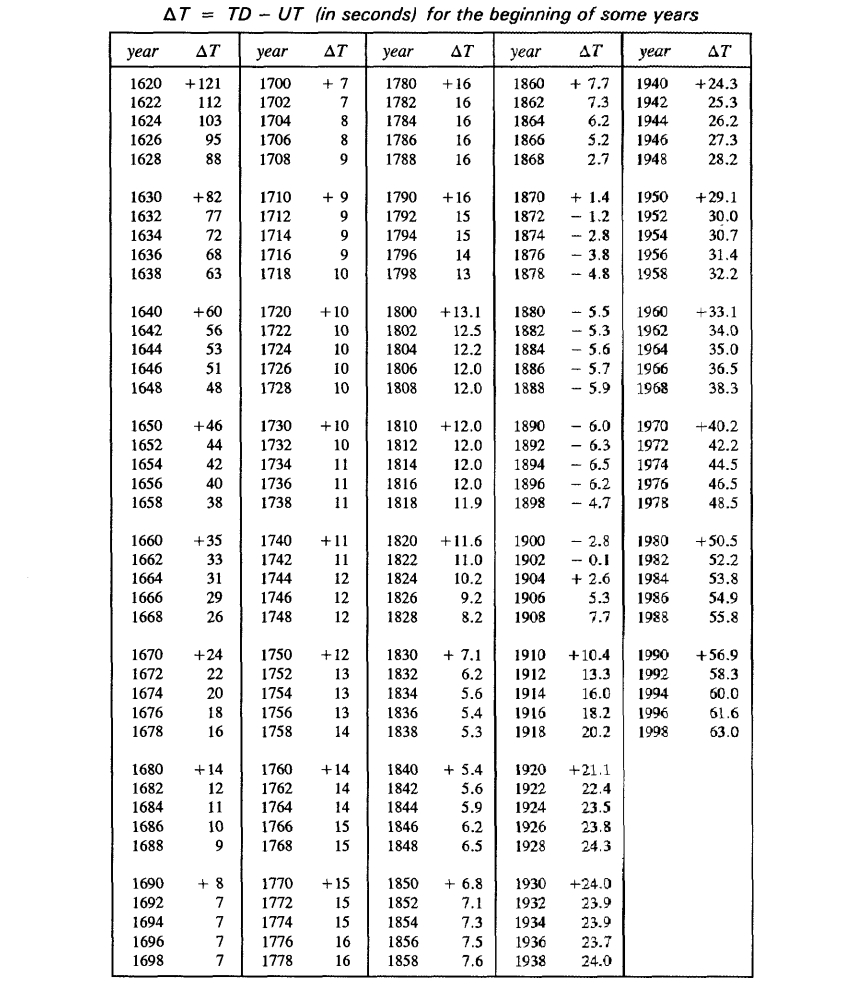
ΔT cannot be calculated from theory. It is measured, today with radio telescopes that track distant quasars, and in the past from timed observations of lunar occultations. For ancient times it is reconstructed from recorded eclipses, which is why the uncertainty grows so fast as you go back in time:
| Year | ΔT | Source |
|---|---|---|
| 500 BC | about 17,200 s (4.8 h) | Babylonian eclipse records |
| AD 0 | about 10,600 s (2.9 h) | Ancient eclipses |
| AD 1000 | about 1,600 s (26 min) | Arab and Chinese records |
| 1600 | about 120 s | Telescopic observations |
| 1900 | −2.7 s | Lunar occultations |
| 1950 | 29.1 s | Occultations and atomic clocks |
| 2000 | 63.8 s | Atomic clocks and VLBI |
| 2020 | 69.4 s | IERS |
| 2025 | about 69.1 s | IERS |
ΔT was negative around 1900 because the reference was chosen to match the average rotation of the 19th century, when the Earth spun slightly faster than it does now.
Why ΔT matters
The Earth turns 15° every hour. An error of one hour in ΔT therefore moves the predicted track of a solar eclipse by 15° of longitude, more than 1,000 km at mid-latitudes. When historians want to know whether a solar eclipse recorded in an ancient chronicle was total at a given city, ΔT is the critical number.
For the present day the effect is smaller but still visible. Ignoring ΔT would shift the predicted time of a lunar occultation by more than a minute, and in that time the Moon moves about 38″ against the stars. Predictions of occultations, eclipse contact times and satellite passes are always computed in TT and then converted to UT with the best available ΔT.
Leap seconds and UTC
The time on our watches is Coordinated Universal Time (UTC). It ticks at the atomic rate, but it is kept within 0.9 s of the Earth's rotation by inserting leap seconds. Since 1972, 27 leap seconds have been added, the last one on 31 December 2016.
Recently the Earth has been turning slightly faster, so no leap second has been needed since then, and ΔT has even decreased a little since 2020. In 2022 the General Conference on Weights and Measures decided that the tolerance between UTC and the Earth's rotation will be widened by 2035, which in practice ends leap seconds.
Predicting ΔT is hard
Future values of ΔT can only be extrapolated. In 1998 Meeus proposed the formula ΔT = 102 + 102 t + 25.3 t² + 0.37 (year − 2100) seconds, with t = (year − 2000) / 100, which gives about 103 s for 2026. The Espenak–Meeus polynomial of 2006 gives about 75 s. The observed value is about 69 s, because the Earth has been turning faster than expected since the early 2000s.
Even the best predictions drift by several seconds within a decade. This is why eclipse predictions for the far future are given for a range of possible ΔT values.
Observed ΔT, 1600–2000
Explore it on AstroAlgos
Frequently asked questions
What is ΔT?
ΔT is the difference between Terrestrial Time, a uniform atomic time scale, and Universal Time, which follows the Earth's rotation: ΔT = TT − UT. It is about 69 seconds in 2026.
Why does the Earth's rotation slow down?
Mainly because of tidal friction: the tides raised by the Moon act as a brake and transfer angular momentum to the Moon, which slowly moves away. Movements in the core, the oceans and the atmosphere add irregular changes on top of this.
Are leap seconds still added?
The last one was added on 31 December 2016. The Earth has been turning slightly faster since then, and in 2022 the international authorities decided to widen the tolerance by 2035, which in practice ends leap seconds.